Brendan Corey Vows Aggressive Racing Despite Throat Slash Injury
In the high-stakes world of short track speed skating, where blades slice through ice at blistering speeds and split-second decisions can mean victory or disaster, Australian athlete Brendan Corey has emerged as a symbol of unbreakable resilience. The Canadian-born skater, who represents Australia through his family ties, faced a harrowing ordeal at the 2025 Beijing World Championships when a competitor's blade slashed his throat. Yet, as the 2026 Winter Olympics in Milan-Cortina approach, Corey is not just recovering—he's charging forward with the same bold aggression that defined his career.
The Shocking Incident in Beijing
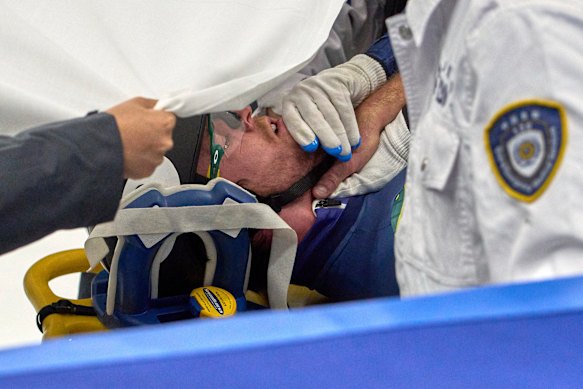
The drama unfolded during the chaotic final lap of the 1000m quarter-final at the Beijing World Championships. Corey, crouched low and accelerating from third place, attempted a daring pass between opponents. In a split second, the upright blade of China's Liu Shaoang caught his neck, slicing through skin and fracturing his thyroid cartilage. Blood poured onto the ice as Corey collapsed, stretchered off in a scene that stunned spectators worldwide.
Medical teams acted swiftly, stitching the four-inch gash and confirming that, miraculously, no major arteries or the larynx were severed. Corey lost his voice temporarily and could only manage liquids for weeks, but his physical recovery was remarkably swift. 'It was a freak accident in a sport full of them,' Corey reflected in a recent interview. The incident, captured in heart-pounding footage, highlighted the inherent dangers of short track speed skating—a discipline where athletes hurtle around a 111-meter oval at up to 50 km/h, blades just millimeters from flesh.
Understanding the Risks of Short Track
Short track speed skating, an Olympic event since 1992, combines the precision of figure skating with the intensity of sprinting. Crashes are common; blades can flip upright during falls, turning the ice into a potential minefield. Corey's mishap echoes past tragedies, like the 2010 death of luger Nodar Kumaritashvili, underscoring why mental fortitude is as crucial as physical prowess in winter sports.
For Australia, a nation more synonymous with summer beaches than snowy tracks, Corey's story adds to a growing legacy in winter disciplines. With limited ice facilities Down Under, athletes like him train overseas, often in Canada or Europe, building a reputation for toughness against global powerhouses like South Korea and China.
Recovery and a Changed Yet Unchanged Mindset
By mid-2025, Corey was back on the ice, his scar a faint reminder of the near-miss. Physiotherapy and mental coaching helped him regain full strength, but the psychological impact lingered. Would the adrenaline-fueled aggression that earned him a bronze medal in the 1500m at the 2024 Rotterdam World Championships—Australia's first in short track in 20 years—be tempered by fear?
'I've put that behind me,' Corey insists. 'In the moment, it felt like the right move to go for the pass. I didn't want to just sit back.' Now wiser, he admits to being 'a bit smarter' about risks, especially in qualifiers where a penalty could derail Olympic hopes. Yet, his core philosophy remains: 'I'm not afraid to throw myself into the mix.' This blend of caution and daring positions him well for the Milan Olympics, where he'll compete in the 500m, 1000m, and 1500m events, plus relays.
Achievements and Olympic Aspirations
Corey's journey to the Olympics is one of perseverance. Born in Canada, he moved to Australia as a teen and quickly rose through the ranks. His 2024 bronze was a breakthrough, signaling Australia's potential in a sport dominated by Asia and Europe. Training at the High Performance Centre in Salt Lake City, Corey has honed a skating style that's aggressive yet tactical, focusing on explosive starts and resilient finishes.
Looking ahead to Milan-Cortina 2026, Corey eyes the podium. 'Short track is unpredictable—anything can happen,' he says. 'I'm physically ready, and I'll keep a level head.' Experts agree; his recovery has only amplified his mental edge. Analysts predict he could challenge for medals in the 1000m, the very distance where fate tested him most severely.
The Broader Impact on Australian Winter Sports
Corey's saga resonates beyond the individual. For Australian winter sports, which receive far less funding than AFL or cricket, stories like his inspire investment and participation. Speed Skating Australia has seen a uptick in young recruits, drawn to the thrill and danger. Federations are pushing for better safety protocols, like blade guards, though purists argue it would alter the sport's raw essence.
In Milan, Corey won't just race for himself—he'll carry the hopes of a nation adapting to winter's challenges. His determination challenges the narrative of Australia as a summer sports powerhouse, proving that grit transcends climates.
Lessons from the Ice
Brendan Corey's story is a masterclass in resilience. In a sport where one lapse can end a career—or worse—he chooses boldness over hesitation. As the Olympics near, all eyes will be on whether his throat slash becomes a footnote or a defining chapter in Olympic lore. For now, the Australian skater is laced up, ready to carve his path on the ice once more.
This article draws from interviews and official reports, highlighting Corey's journey as a beacon for aspiring athletes worldwide.