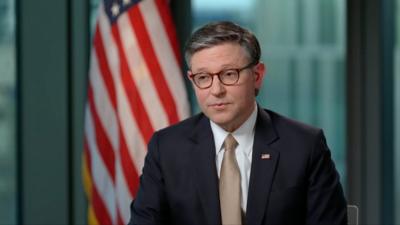
London, UK – In a recent high-profile interview with the BBC’s Sunday with Laura Kuenssberg, the Speaker of the United States House of Representatives, Mike Johnson, has firmly stated that diplomatic engagement is the only viable path forward regarding the geopolitical status of Greenland. This statement comes amidst a backdrop of shifting international priorities and recent contentious rhetoric from former President Donald Trump concerning the Arctic territory.
The interview provided a rare glimpse into the current Republican leadership's stance on sensitive foreign policy matters, particularly those involving key NATO allies like Denmark, Greenland’s sovereign partner. Speaker Johnson, a close ally of former President Trump, was pressed on the administration's intentions following Trump's suggestion of acquiring Greenland, a topic that has long simmered in international political circles.
The Diplomatic Imperative Over Military Options
When directly questioned about the potential for the US to pursue Greenland through means other than negotiation, Speaker Johnson was resolute. "Diplomatic channels are the way to go," Johnson asserted, effectively ruling out any scenario involving military intervention. This declaration serves to calm anxieties among European partners and underscores a commitment, at least from the current Speaker’s perspective, to established international norms for territorial acquisition or partnership.
The context of this reassurance is crucial. Greenland, with its vast strategic location in the Arctic and significant mineral resources, has become an increasingly important focal point for global powers. While its primary relationship is with Denmark, the US maintains a long-standing military presence through Thule Air Base, making any shift in its status a matter of significant international concern.
Navigating Trump’s Rhetoric and Policy
Johnson’s comments were particularly timely, as they preceded an announcement by Donald Trump regarding significant punitive tariffs against several European nations, including the UK and Denmark. Trump reportedly planned to impose a 10% tariff on "all or any goods" exported to the US from these countries starting February 1st. While the Speaker did not explicitly link his diplomatic assurance to the tariff threat, the timing suggests a delicate balancing act within the Republican political sphere—reassuring allies on core security issues while navigating the populist trade policies championed by Trump.
For the UK and Denmark, nations deeply integrated into the transatlantic alliance, any perceived threat to sovereignty or trade stability via Greenland is taken seriously. The BBC’s coverage highlighted local reactions, with some Greenlanders expressing concern or even disbelief regarding the external powers’ fixation on their island.
Geopolitical Significance of Greenland
The intense international interest in Greenland is not merely historical; it is rooted in contemporary strategic and economic realities. The melting Arctic ice cap is opening up new shipping lanes, making the region vital for global commerce and military positioning. Furthermore, Greenland possesses substantial reserves of rare earth minerals, essential components for modern technology, renewable energy infrastructure, and defence systems.
The United States has long viewed Greenland as a crucial component of its northern defence strategy. Maintaining stable, cooperative relations with the Danish government and the autonomous Greenlandic government is paramount to US security interests in the region, especially given rising competition from other global actors seeking influence in the Arctic.
Johnson’s emphasis on diplomacy suggests an acknowledgement that unilateral or forceful actions would severely damage NATO cohesion and undermine decades of established partnerships. The preference for negotiation aligns with traditional US foreign policy doctrines that favour strong alliances over isolationist or aggressive unilateralism, even when dealing with politically sensitive domestic allies like the former President.
The Future of US-Danish Relations
The Speaker’s interview served as a vital communication bridge to European capitals. By publicly favouring diplomatic channels, Johnson signals a commitment to de-escalation and multilateral problem-solving. This is crucial for the relationship between Washington and Copenhagen, which has recently faced strain over trade disputes and differing views on international security priorities.
As the global focus shifts increasingly towards the Arctic, the clarity provided by Speaker Johnson is significant. It suggests that while political rhetoric may fluctuate, the operational reality of US policy, at least as articulated by the House Speaker, remains anchored in established diplomatic procedures. The coming months will test this commitment as the US seeks to balance its strategic ambitions with the need to maintain robust alliances in the face of evolving global challenges, from trade disputes to territorial interests in the far north.
The BBC’s coverage underscored that for the people of Greenland and their Danish counterparts, the primary concern remains stability and self-determination, reinforcing the necessity for respectful, diplomatic engagement from all international stakeholders.