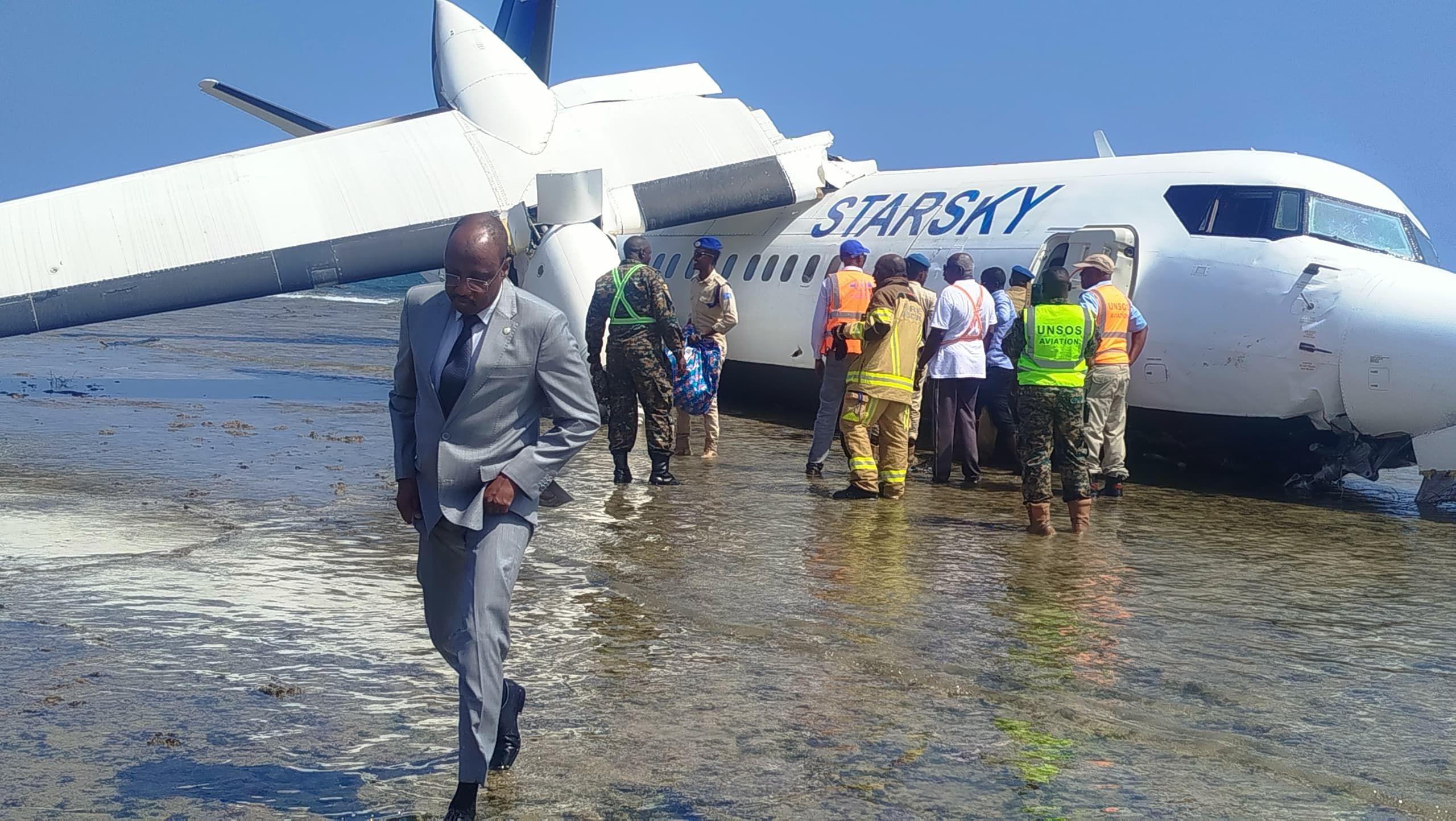
In a heart-pounding aviation drama that could have ended in tragedy, a skilled pilot from Starsky Aviation has been hailed as a hero after executing a daring crash-landing on the shores of the Indian Ocean near Mogadishu, Somalia. The incident, which unfolded on a crisp Tuesday morning in February 2026, involved a Fokker 50 passenger plane carrying 50 passengers and five crew members. Miraculously, all 55 individuals on board walked away with no serious injuries, thanks to the pilot's swift and composed response to a sudden technical malfunction.
The Incident Unfolds
The flight, originally bound for the semi-autonomous region of Puntland, departed from Aden Adde International Airport in Mogadishu without issue. But mere minutes into the journey, the crew detected a critical problem with the aircraft. According to Somalia's Civil Aviation Authority (CAA), the pilots immediately radioed for permission to return to the capital's airport. The tense return flight set the stage for what would become one of the most talked-about aviation saves in recent African history.
Upon touchdown, disaster struck in a different form: the plane failed to decelerate properly on the runway. It overshot the tarmac, barreling toward the airport's edge, which sits perilously close to the Indian Ocean's lapping waves. In a split-second decision, the pilot veered the aircraft onto the adjacent seashore, bringing it to a halt in shallow waters. Eyewitness footage circulating on social media platforms like X (formerly Twitter) captured the surreal scene: the propeller plane partially submerged, its wings gently rocked by the tide under a clear blue sky, as passengers calmly evacuated via emergency exits.
Technical Fault Under Scrutiny
The exact nature of the technical fault remains shrouded in mystery as investigations kick off. CAA Director Ahmed Macalin Hassan confirmed that the issue was reported shortly after takeoff, but specifics—whether it involved engines, hydraulics, or braking systems—have yet to be disclosed. Starsky Aviation, a relatively new player in Somalia's fragile aviation sector, issued a statement emphasizing the pilot's role. Spokesman Hassan Mohamed Aden noted, "The pilot's swift and calm decision-making played a decisive role in ensuring the safety of everyone on board."
This event highlights ongoing challenges in Somalia's aviation infrastructure. The country, still recovering from decades of conflict, has seen sporadic improvements in air travel but remains plagued by outdated equipment and limited maintenance resources. The Fokker 50, a workhorse from the 1980s and '90s, is common in Africa's regional routes but has faced criticism for reliability issues in harsh environments.
Rescue and Response: A Coordinated Effort
The response to the crash-landing was swift and multifaceted, underscoring the international support bolstering Somalia's security. The African Union's mission in Somalia (AMISOM) reported that UN and AU troops were deployed almost immediately to secure the site and assist with evacuations. Somalia's Transport Minister personally visited the scene, a gesture that reassured the public amid heightened concerns over air safety.
Passengers, many of whom were traveling for business or family visits to Puntland, described the ordeal as terrifying yet testament to the crew's professionalism. One survivor, speaking anonymously to local media, said, "We thought it was over when we hit the water, but the pilot kept us steady. He's a true lifesaver." Medical teams on standby treated minor cuts and bruises, but no hospitalizations were required—a stark contrast to more fatal incidents in the region.
International Echoes and Safety Implications
News of the incident rippled across global aviation circles, drawing parallels to other miraculous landings, such as the 2009 'Hudson River Miracle' in New York. Experts praise the pilot's choice to aim for the soft shoreline rather than risk a high-speed collision with barriers. However, it also reignites debates on aviation safety in conflict zones. Somalia's proximity to piracy hotspots and al-Shabaab threats already complicates flights, and this event could prompt calls for enhanced oversight from bodies like the International Civil Aviation Organization (ICAO).
Starsky Aviation, which operates a small fleet serving domestic and regional routes, has promised full cooperation with investigators. The airline's track record is mixed; while it has expanded access to remote areas, past delays and minor incidents have raised eyebrows. This crash-landing, though, positions it as a story of resilience rather than recklessness.
Broader Context: Aviation in Somalia
Mogadishu’s Aden Adde International Airport, renovated in 2014 with Turkish aid, symbolizes Somalia's tentative steps toward stability. Yet, its location—mere meters from the ocean—poses inherent risks, as this incident vividly illustrates. Winds from the Indian Ocean can affect runways, and the sandy terrain offers little margin for error during emergencies.
Analysts point to systemic issues: underfunded regulatory bodies, a shortage of certified mechanics, and reliance on aging aircraft. In 2025 alone, Somalia reported several near-misses, prompting the CAA to introduce stricter pre-flight checks. This event may accelerate those reforms, potentially including mandatory simulator training for shoreline scenarios—a niche but vital skill in coastal airports.
From an environmental angle, the shallow-water landing minimized ecological damage, with the plane's position allowing quick salvage without deep-sea operations. Local fishers assisted in the aftermath, a heartwarming display of community solidarity in a nation often defined by hardship.
Looking Ahead: Lessons from the Shore
As the sun set on the stranded Fokker 50, the focus shifted from panic to gratitude. The pilot, whose name has not been released pending formal commendation, embodies the unsung heroes of aviation in developing regions. Starsky Aviation plans a review of all its planes, while the CAA vows a transparent probe to prevent recurrences.
For passengers and the Somali public, this is more than a close call—it's a beacon of hope. In a country rebuilding from civil war, such stories remind us of human ingenuity triumphing over adversity. As investigations continue, one thing is clear: the pilot's actions turned potential catastrophe into a tale of survival, etching his legacy on Somalia's sandy shores.
(Word count: 748)
