The UK and the world are holding their breath as NASA prepares for a monumental leap back into deep space. The Artemis II mission, the first crewed flight to the Moon in over half a century, is scheduled to commence its journey in early 2026, paving the way for future lunar landings and a sustained human presence beyond Earth orbit.
This pivotal 10-day mission is not about planting a flag; it’s about rigorous testing. It will validate the performance of the massive Space Launch System (SLS) rocket and the Orion spacecraft with astronauts aboard, ensuring the hardware is ready for the Artemis III landing crew.
The Countdown Begins: Artemis II Launch Timeline
The path to launch is complex, involving critical ground operations. In preparation for the earliest possible launch window, NASA plans the significant rollout of the SLS rocket and Orion capsule from the Vehicle Assembly Building (VAB) to the launch pad this Saturday. This four-mile journey, conducted via the massive crawler-transporter-2, is expected to take up to 12 hours.
Pad Preparations and Wet Dress Rehearsal
Once stationed at the pad, engineers will commence the final hookups of essential ground support equipment, including electrical systems and cryogenic propellant feeds. A crucial pre-launch test, known as a wet dress rehearsal—where the rocket is fully fueled—is slated for the end of January. Should any issues arise during this phase, the stack may be rolled back to the VAB for essential modifications.
If all systems achieve a green light, the earliest launch opportunity is set for Friday, 6 February 2026. Due to the geometry required for the Moon trajectory, launch opportunities are clustered. Potential windows for the Artemis II mission include:
- February: 6, 7, 8, 10, and 11
- March: 6, 7, 8, 9, and 11
- April: 1, 3, 4, 5, and 6
Meet the Artemis II Crew: Pioneers of Deep Space
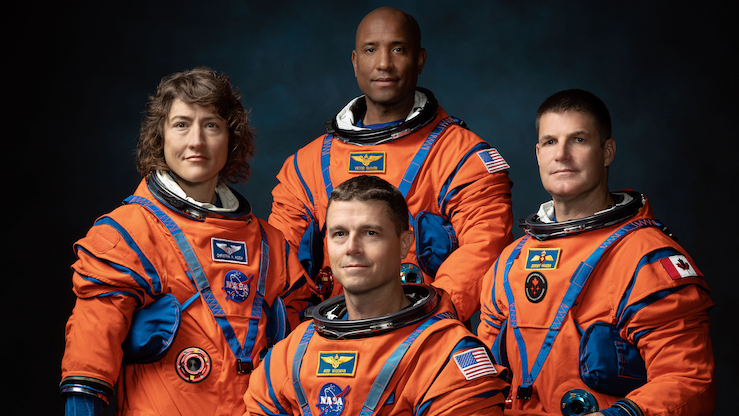
The four-person international crew selected for this historic flight represents a new era of global collaboration in space exploration. The team is tasked with pushing the boundaries of human endurance and spacecraft capability far beyond Low Earth Orbit (LEO).
The Astronaut Line-Up
The crew comprises three NASA astronauts and one Canadian Space Agency (CSA) astronaut:
- Reid Wiseman (Commander): Leading the mission from the command seat.
- Victor Glover (Pilot): Navigating the complex flight profile.
- Christina Koch (Mission Specialist 1): Bringing extensive ISS experience to deep space.
- Jeremy Hansen (Mission Specialist 2, CSA): Marking Canada’s first crewed lunar mission flight.
Mission Objectives: Testing the Limits of Orion
The Artemis II mission is fundamentally a systems check in the harsh environment of deep space. The primary goal is to thoroughly test the Orion spacecraft’s handling, life support, and propulsion capabilities.
In-Orbit Maneuvers and Deep Space Check
Shortly after achieving Earth orbit, the crew will manually fly the capsule to practice steering and alignment procedures critical for future lunar descents. Following this, the mission profile takes Orion thousands of kilometres beyond the Moon. During this extended trajectory, the crew will monitor and stress-test the spacecraft’s critical life-support, navigation, and power systems.
Furthermore, the astronauts will serve as invaluable test subjects, relaying vital data and imagery back to Earth regarding radiation exposure—which will be higher than on the International Space Station but deemed safe—and their physiological responses in a weightless, deep-space environment.
The mission concludes with a high-speed, high-energy atmospheric reentry, culminating in a splashdown in the Pacific Ocean off the US west coast.
Laying the Groundwork for Artemis III and Beyond
It is crucial to note that Artemis II will not land on the Moon. Its success is the prerequisite for Artemis III, the mission designated to return humans to the lunar surface for the first time since the Apollo era.
The Lunar Landing and Future Base
NASA currently targets the Artemis III launch for “no earlier than” 2027, though industry experts suggest 2028 is a more realistic timeframe, pending the readiness of crucial ancillary hardware. This includes the final selection of the lunar lander—either SpaceX’s Starship or Blue Origin’s proposed vehicle—and the deployment of new Axiom-designed spacesuits.
The ultimate goal extends far beyond a single landing. Subsequent missions, Artemis IV and V, will commence the construction of the Gateway, a small space station orbiting the Moon. This infrastructure will support sustained human presence, enabling regular lunar landings near the Moon's resource-rich south pole, and forming a staging post for eventual missions to Mars.
As the SLS rocket awaits its moment, the world watches on, ready for the next chapter of human exploration to begin.