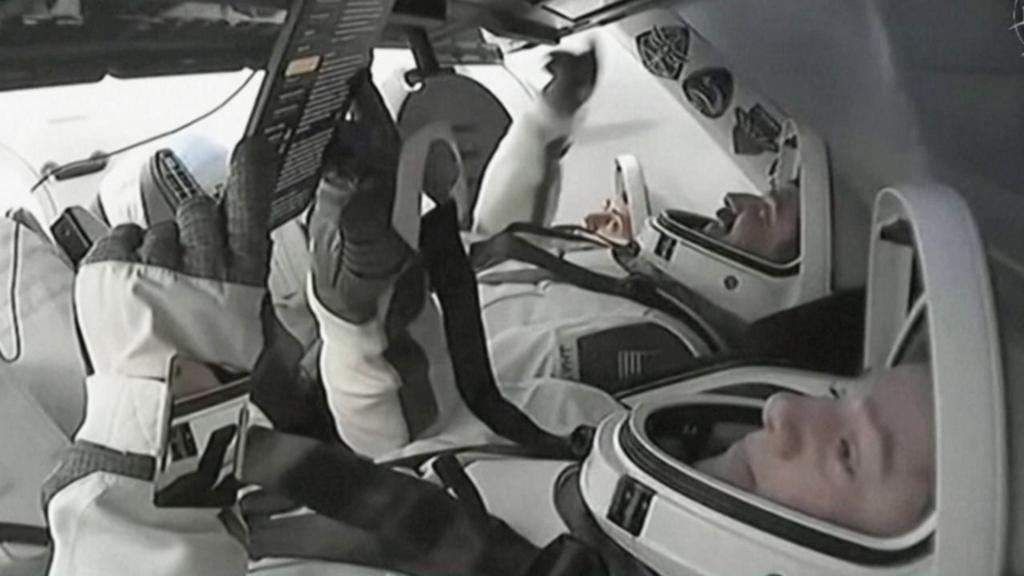
In a breathtaking display of human ingenuity and cosmic ambition, four astronauts have successfully blasted off from Cape Canaveral, embarking on an eight-month mission to the International Space Station (ISS). The SpaceX Dragon spacecraft, propelled by a powerful Falcon 9 rocket, carried NASA astronauts Jessica Meir and Jack Hathaway, European Space Agency's Sophie Adenot, and Roscosmos's Andrey Fedyaev into Earth's orbit, marking another significant milestone in international space collaboration.
A View of Our Unique Planet
As the spacecraft ascended, the astronauts were treated to an unparalleled view of our home planet. For the newly launched crew, the experience of seeing Earth from space was deeply profound. Commander Jessica Meir articulated the sentiment shared by many who have had the privilege of witnessing our world from afar: "We know [Earth] is utterly unique, fragile and must be protected." This powerful statement underscores the growing awareness of Earth's delicate ecosystem and the importance of preserving it, a perspective often amplified by the vantage point of space.
The mission, designated Crew-12, will see the astronauts replace a team that recently evacuated the ISS due to a medical emergency, highlighting the dynamic and sometimes challenging nature of long-duration spaceflight. The crew's gratitude and readiness for the journey ahead were palpable, as Meir added, "Crew-12 is grateful and ready for the journey ahead."
The International Space Station: A Marvel of Engineering
The International Space Station, the destination for the Crew-12 mission, is a testament to what can be achieved through global cooperation in space exploration. Costing an estimated $150 billion (£110 billion) to construct, it stands as the most expensive object ever created by humanity. Since 1998, this orbiting laboratory has been a constant presence in space, continuously inhabited by astronauts since 2000. It orbits Earth at an altitude of approximately 250 miles (402km).
A Hub for Scientific Discovery
Composed of interconnected pressurized modules contributed by space agencies from the USA, Russia, Europe, Japan, and Canada, the ISS has been gradually expanded over the decades. With a length of 109 meters (356ft), it offers living space comparable to an average six-bedroom house. It features six sleeping quarters, two bathrooms, a gym, and a spectacular 360-degree observation bay window, providing breathtaking views of Earth and the cosmos. Onboard, the crew undertakes a wide array of experiments and technology testing, fulfilling NASA's goal of "unlocking discoveries not possible on Earth."
A Moment of National Pride in France
The launch held particular significance for France, as Sophie Adenot became the country's second female astronaut to journey into space. The 43-year-old airforce helicopter pilot, who grew up in rural Burgundy, was inspired to pursue her dream of space exploration at the age of 14, when France's first female astronaut, Claudie Haigneré, travelled to the Russian space station Mir. Adenot recounted this pivotal moment: "I was 14 and it was like a switch was turned on in my head. If a woman can do it, then why not me?" Her family's unwavering support, encouraging her to pursue her challenging aspirations, further fueled her determination.
Adenot's path to space was marked by rigorous training at Supaéro in Toulouse, France's elite aerospace university, followed by a distinguished career in the airforce as a helicopter test pilot. Her journey serves as an inspiration for aspiring astronauts worldwide, demonstrating that dedication and perseverance can turn even the most ambitious dreams into reality.
Experiencing the Wonders of Weightlessness
Approximately 45 minutes after lift-off, the Crew-12 astronauts began to experience the unique sensation of weightlessness. As the Dragon capsule accelerates towards the ISS at speeds of around 27,000 kmh (16,777mph), astronauts Sophie Adenot and Jack Hathaway, among others, are now floating freely within the spacecraft. This initial experience of microgravity is a defining characteristic of space travel, allowing for movement and activities impossible on Earth.
During their approximately 34-hour journey to the ISS, the crew will have the opportunity to remove their bulky spacesuits and move around the capsule. This period allows them to acclimatize to their new environment and prepare for their extended stay aboard the orbiting laboratory. The successful launch and initial phase of the mission underscore the continued strength of NASA and its international partners in pushing the boundaries of human exploration.