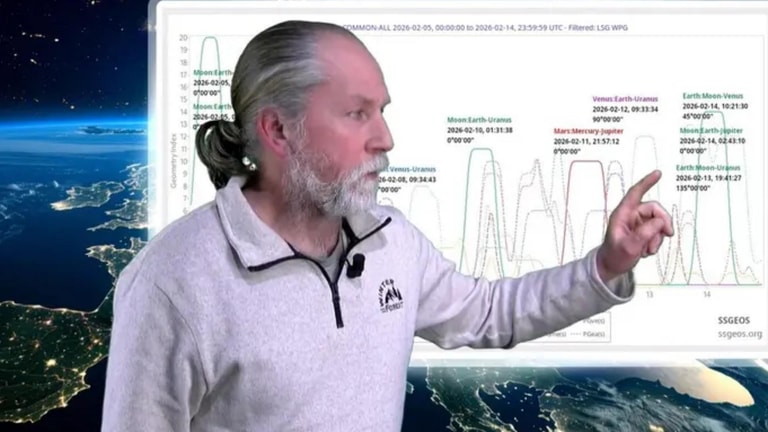
Dutch Expert Warns of Possible Earthquake Surprise in February
In a world where natural disasters can strike without warning, the predictions of seismic researchers often spark both curiosity and concern. Frank Hoogerbeets, a Dutch seismologist known for his unconventional approaches to earthquake forecasting, has once again captured global attention. In a recent video shared on social media, Hoogerbeets issued a stark warning about potential seismic activity between February 13 and 15, 2026, hinting at a possible "surprise" event triggered by the alignment of Earth, the Moon, and Jupiter.
Who is Frank Hoogerbeets and Why Should We Listen?
Frank Hoogerbeets is not your typical seismologist. Working with the Solar Terrestrial Research group in the Netherlands, he specializes in what he terms "planetary geometry"—the study of how alignments of celestial bodies might influence Earth's geological activity. His methods blend astronomy with seismology, a controversial field that mainstream scientists often view with skepticism. Yet, Hoogerbeets has a track record of predictions that have aligned with real events, including the devastating 2023 Turkey-Syria earthquakes, which he flagged days in advance based on similar cosmic configurations.
Hoogerbeets' approach challenges traditional seismology, which relies on monitoring tectonic plates, fault lines, and ground vibrations. Instead, he argues that gravitational pulls from planets and the Moon can subtly stress Earth's crust, potentially triggering quakes in vulnerable areas. While his theories aren't universally accepted, they prompt important discussions about integrating diverse data sources for disaster prediction.
The Science Behind Planetary Alignments and Earthquakes
At the heart of Hoogerbeets' warning is the upcoming alignment of Earth, the Moon, and Jupiter. During this period, these bodies will form a near-straight line in the sky, a configuration he believes amplifies tidal forces on our planet. Tidal forces, primarily from the Moon and Sun, are well-known to cause ocean tides, but their effects on solid Earth—known as earth tides—can reach deep into the crust, stressing fault lines.
Scientific studies, such as those published in the journal Geophysical Research Letters, have explored correlations between lunar phases and seismic events. Full moons and new moons, when tidal forces peak, show slight increases in earthquake frequency in some regions. Jupiter, the solar system's largest planet, adds another layer: its immense gravity could subtly influence these dynamics during rare alignments. Hoogerbeets uses software to model these positions, claiming they correlate with historical quakes like the 2011 Japan tsunami.
Critics, including the U.S. Geological Survey (USGS), caution that while correlations exist, causation is unproven. "Earthquakes are driven by internal tectonic forces, not external planetary ones," a USGS spokesperson noted in response to similar predictions. However, with climate change and human activities increasing seismic risks, exploring all angles—including astronomical ones—could enhance early warning systems.
The Predicted 'Surprise': What Could Happen?
Hoogerbeets didn't specify locations in his video, but his broad warning applies globally, with particular relevance to seismically active regions. In the US, this includes the West Coast's San Andreas Fault, Alaska's volatile zones, and even the New Madrid Seismic Zone in the Midwest, which could produce devastating intraplate quakes.
The term "surprise" suggests an unexpected magnitude or location—perhaps a moderate quake escalating into something larger, or an event in a quieter area. Historical precedents abound: the 1989 Loma Prieta quake in California (magnitude 6.9) caught many off guard despite foreshocks. If Hoogerbeets is right, the February alignment could coincide with increased activity, urging vigilance from Hawaii to Puerto Rico.
For Americans, this prediction resonates amid recent seismic upticks. The USGS reports over 1,000 quakes annually in California alone, with a 7.0+ event overdue in some forecasts. Integrating Hoogerbeets' alert with tools like the USGS Earthquake Notification Service could save lives by prompting preemptive measures.
Implications for the United States
The US faces unique earthquake challenges due to its vast, diverse geology. The Pacific Ring of Fire encircles the West, making states like California, Oregon, and Washington prime candidates for activity. A 2023 FEMA report estimates that a major San Francisco quake could cause $100 billion in damage and displace millions.
Hoogerbeets' warning arrives as the nation bolsters resilience. Initiatives like the Great ShakeOut drills simulate mega-quakes, while apps like MyShake provide real-time alerts. If planetary alignments play even a minor role, they could inform risk models, especially for tsunamis triggered by offshore quakes—a threat to coastal cities from Seattle to San Diego.
Experts recommend treating such predictions as calls to action rather than certainties. "Predictions like this remind us to stay prepared," says Dr. Lucy Jones, a prominent USGS seismologist. Bolstering infrastructure, like retrofitting bridges in earthquake-prone areas, is crucial.
Preparing for Potential Seismic Events
Whether or not the alignment triggers a quake, preparation is key. Hoogerbeets urged "extreme caution," and for good reason. Here's how individuals and communities can gear up:
- Build an Emergency Kit: Stock non-perishables, water, flashlights, and medications for at least 72 hours.
- Secure Your Home: Anchor heavy furniture and install quake valves on gas lines.
- Stay Informed: Download USGS apps and follow local alerts.
- Practice Drills: Participate in family evacuation plans and community exercises.
- Know the Signs: Watch for foreshocks, animal behavior changes, or unusual ground rumbling.
Government agencies like FEMA emphasize that 80% of earthquake damage is preventable with proactive steps. In the lead-up to February 13-15, states could ramp up monitoring, deploying additional seismographs in high-risk zones.
Skepticism vs. Vigilance: Balancing the Debate
Hoogerbeets' predictions divide opinions. Supporters hail his 70-80% hit rate on past alerts, while detractors label it pseudoscience. A 2024 study in Nature Geoscience found weak but intriguing links between solar activity and quakes, suggesting interdisciplinary research is warranted.
Ultimately, in an era of accelerating disasters—from wildfires to floods—erring on the side of caution benefits all. As Hoogerbeets concludes in his video, "A surprise could happen." For the US, this means redoubling efforts to safeguard lives and property against nature's unpredictability.
This story underscores the evolving landscape of disaster science, where ancient skies meet modern tech. Stay tuned to Everythiiing.com for updates as February approaches.
